
Rediscovering Malaga: Authentic Tapas and Old World Charm
Some places change so much that returning to them feels like arriving somewhere entirely new. Malaga was one of those places for us.
When Brien and I stepped off the plane this October, the memories came quickly. We had first known the Costa del Sol in the 1980s, when life along the coast felt slower and softer around the edges. We spent a glorious month there then, drifting between sunlit markets, quiet beaches, and small places where lunch stretched easily into the afternoon.
Back then, the region had a laid-back charm that seemed almost untouched by the modern world. Fast forward to 2026, and Malaga has grown into something far more layered. It is bigger, brighter, busier, and more polished. Yet under all that new energy, parts of the old city still remain.
That was what drew us back. After two short visits over the past five years, we wanted more time to wander, eat, look, listen, and reconnect with the birthplace of our favourite artist, Pablo Picasso. What we found was a city balancing old-world warmth with a confident new sense of itself.

Returning to the Costa del Sol after decades away
Memory can be a generous editor. It softens noise, removes inconveniences, and keeps only the golden parts. Our memories of the Costa del Sol from the 1980s were full of sun, salt air, local markets, and beaches that still felt like they belonged mostly to the people who lived nearby.
Of course, tourism was already part of the coast then. But it had not yet reached the scale we see now. There was less polish and more spontaneity. We remember walking through markets where produce was piled high without fuss, fish was fresh, and the rhythm of the day seemed to follow local habits rather than visitor schedules.
Returning after so many years meant accepting that we would not find that exact place again. Cities do not wait for us. They keep building, selling, adapting, and reinventing themselves. Malaga has done all of that, and then some.
The airport is busier. The city centre draws crowds. Cruise passengers pour through for the day. New hotels, smart restaurants, galleries, and shops have made Malaga feel far more international than the city we remembered.
Yet the surprise was not how much had changed. The surprise was how much feeling remained.
Malaga has learned to live with its layers
Malaga now wears several identities at once.
It is a port city. It is a beach city. It is a cultural city. It is a weekend escape, a cruise stop, and a place where locals still do their shopping, meet friends, and fuss over the right spot for coffee or lunch.
That mix gives the city its pull. One moment you are passing modern glass and sharp new design. The next, you are standing beside old stone, Roman remains, Moorish walls, or a church doorway that has seen centuries of arrivals and departures.
The historic centre can feel crowded, especially in the middle of the day. Tour groups gather. Restaurant hosts hold menus. Luggage wheels rattle over the pavement. Still, a few turns away, the mood can change quickly. A side street narrows. A bar fills with local voices. Someone leans in a doorway with a cigarette and a coffee. A delivery cart squeezes past. Life continues.
This is what we came to appreciate during our longer stay. Malaga rewards the unhurried visitor. It does not reveal its best self only through major sights, although there are many. It reveals itself in pauses.
A quiet square before lunch. A glass of wine at a standing-room-only counter. The smell of frying fish. The flash of tiled walls. The pause in conversation when a plate arrives and everyone at the table turns to look.
For us, Rediscovering Malaga meant looking past the obvious changes and noticing the city’s deeper habits.
The warmth of the Malagueños still sets the city apart
Popular destinations can lose patience with visitors. That is understandable. When a city receives constant attention, the people who live there can feel pushed aside in their own streets.
What stood out in Malaga was how often we felt genuine warmth from the Malagueños. Not the scripted friendliness of tourism, but something more relaxed and direct. People made room. They answered questions. They smiled when we stumbled through a phrase. They seemed proud of their city without turning that pride into performance.
That friendliness shaped the week.
It appeared in small ways. A server pointing us toward a better choice on the menu. A bartender remembering what we had ordered the night before. A stranger helping us understand where to stand in a busy tapas bar. A shopkeeper switching between Spanish and patient English with no sign of irritation.
These moments matter. They are the difference between visiting a city and feeling briefly accepted by it.
Malaga receives enormous numbers of tourists, yet its local character has not disappeared. It has bent and adjusted, but it has not broken. The city still belongs to the people who call it home, and many of them share it with a grace that deserves real credit.
Picasso gives Malaga a personal kind of meaning
Part of our reason for returning was Picasso.
As the birthplace of Pablo Picasso, Malaga carries his presence in ways large and small. There are the expected cultural stops, of course, including museums and places tied to his early life. But for us, the real pleasure came from imagining the city as a source of light, colour, and human theatre.
It is easy to understand why an artist might absorb so much here. The sun sharpens edges. Shadows fall dramatically across walls. Faces gather in cafés, markets, churches, and bars. The city is full of angles, contrasts, and gestures.
We did not want to rush through Picasso’s Malaga as if checking off a list. We wanted to give it time. To walk through the streets with his name in mind. To see the city not only as a travel destination, but as a place that shaped a young imagination.
That changed the pace of our visit. Instead of asking, “What should we see next?” we often asked, “Where should we linger?”
That question led us, again and again, to tapas bars.
The best tapas bars are found by listening
One of our greatest pleasures during the week was searching for the kind of tapas bars that still feel rooted in local life.
The method was simple: follow the sound of Spanish.
Not every good tapas bar is hidden. Not every tourist-facing place is poor. But the bars we loved most had a certain sound before they had a look. They were louder, warmer, and more animated than the places built mainly for visitors. The noise was not unpleasant. It was part of the welcome.
These were rooms filled with quick greetings, laughter, orders called across the counter, plates landing, glasses clinking, and friends talking over one another with no apology. There is a rhythm to a good Spanish bar that cannot be faked. You feel it as soon as you step inside.
We learned to trust that feeling.
If the room was full of locals standing shoulder to shoulder, if the menu seemed short and confident, if the staff moved quickly without fuss, we stayed. If the bar felt too polished, too quiet, or too eager to explain itself, we usually kept walking.
That instinct led us to some wonderful places.
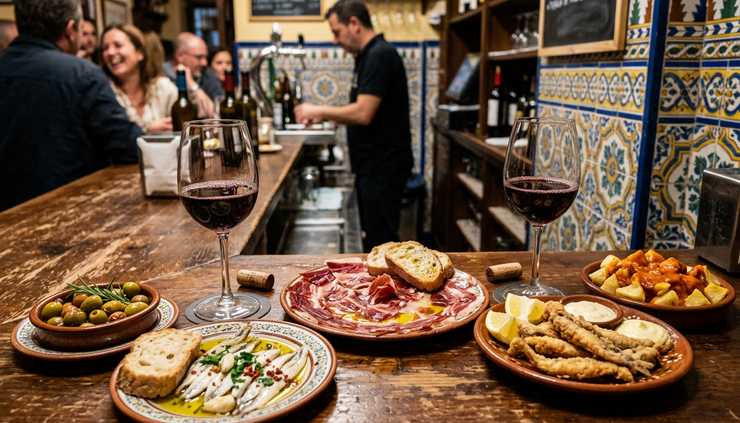
Five tapas bars that gave us the Malaga we were looking for
We were lucky to find several gems during the week. Each one offered something slightly different, but all shared the same essential quality. They felt alive with local habit.
Bar Monteblanco felt easy and local
Bar Monteblanco gave us the kind of unfussy pleasure that makes a quick bite a pleasure. Great coffee and delicious sandwiches.
It was the sort of bar where the food, wine, and conversation all seemed to belong together. We did not feel hurried, nor did we feel staged. We simply settled in and enjoyed being there.
Mesón Mariano delivered old-school comfort
Mesón Mariano has a very traditional feel, which suited us perfectly. This is where we enjoyed the traditional dishes of Malaga - steamed clams, potatoes with chorizo, pork cheek stew and plates of Jamon.
A good traditional tapas bar knows what it does well. It repeats those things day after day, serving people who know exactly what they came for, starting with that complimentary bowl of olives.
Ultramarinos Colmado had character in every corner
Ultramarinos Colmado stood out for its small size and lively atmosphere. Places like this invite looking around. Shelves, bottles, labels, and small signs all add to the experience.
It felt like part shop, part bar, part gathering place. That mix created a strong sense of place. We love spots where the room itself seems to tell stories before the food even arrives.
Vermutería La Clásico made vermouth feel like a ritual
Vermouth has a way of slowing time. At Vermutería La Clásico, it felt less like a drink and more like a small ceremony.
There is something lovely about pausing for vermouth in Spain. It suits late morning, early evening, or any hour when the day needs a gentle hinge. A glass, a small plate, a bit of conversation, and suddenly the city feels more generous.
Bodegas Tranca gave us the hum of Spanish life
Bodegas Tranca was exactly the kind of place we hope to find when travelling. It had energy, noise, colour, and a strong sense of identity.
The pleasure there was not only in what we ate and drank, though both were excellent. It was in the feeling of being surrounded by people enjoying their own city. That is the hum we were looking for. Once you recognize it, you start to seek it everywhere.
What makes a tapas bar feel authentic
Authenticity can be a tricky word. It gets used too often, especially in travel writing. A place does not need to be old, hidden, or difficult to access to be real. Nor does it need to exclude visitors.
For us, an authentic tapas bar in Malaga had a few clear signs:
Local people were eating and drinking there, not just passing through.
The room had energy, often louder than expected.
The menu did not try too hard to explain itself.
Staff moved with the confidence of people who know their regulars.
The food felt connected to habit, season, and appetite.
Wine, vermouth, or beer arrived without ceremony, but with care.
The best places were not precious. They did not perform “Spanishness” for outsiders. They simply got on with being themselves.
That is what travellers should look for. Not perfection. Not a postcard. Just a place with its own pulse.
How to explore Malaga without losing the old charm
Malaga is easy to enjoy on the surface. The weather helps. The sea helps. The architecture, food, and art all help. But to feel its older charm, it pays to move differently.
Walk more slowly than feels efficient. Take side streets without needing them to lead anywhere famous. Eat later than you might at home. Have a drink standing at the bar. Let lunch become the main event. Learn a few Spanish phrases and use them with humility.
Most of all, resist the urge to make every meal a reservation at a highly rated place. We made a mistake of reserving at a Michelin recommended restaurant one night. It was boring expensive and full of tourists! Some of our best moments came from walking, listening, and choosing a bar because it sounded right.
Market Magic at Mercado de Salamanca
While the main market is undeniably lovely, with its stunning glass-fronted entrance drawing visitors in, our hearts were captured by the Mercado de Salamanca. Its beautiful neo-Mudéjar architecture sets it apart as a truly special place, and it quickly became our favourite haunt throughout the week. It was here that we discovered our favourite Jamón supplier, whose cured meats were simply extraordinary. We also stocked up on fragrant spices and the freshest of local produce, making each visit a feast for the senses.
We enjoyed three wonderful lunches at the market bars, sampling the freshest ingredients the region had to offer. And to top it all off, we discovered a fantastic Illy Coffee shop within the market, which became our morning ritual - the perfect start to each day of exploration.
History, Culture and Picasso
The tours of the Alcazaba and the Castle were simply breathtaking, offering stunning views over the city and a fascinating insight into Malaga's rich Moorish history. But perhaps the most moving experiences of the week were our visits to the Picasso Museum and his birthplace. As a lifelong admirer of his work, standing in the very place where this extraordinary genius came into the world was deeply emotional. To visit on the anniversary of his birth made those moments even more profound and unforgettable.
The city has changed, but the welcome remains
By the end of the week, we stopped comparing Malaga to the city we remembered from the 1980s. That old Costa del Sol still exists in our minds, and perhaps in fragments along the coast, but it would be unfair to expect Malaga to remain fixed in time.
The city has grown. It has welcomed more visitors, built more attractions, and claimed a larger place on the cultural map. Some of that change brings pressure. Some of it brings loss. But some of it also brings new life.
What mattered most to us was that Malaga still felt human.
Its old-world charm was there in the tapas bars, in the markets, in the easy humour of servers, in the pride of local people, and in the art-soaked streets that still carry echoes of Picasso. It was there in the way a noisy bar could make two visitors feel, for a short while, part of the room. It's little wonder that Forbes Magazine declared Malaga the best place to live in the world in 2023. This city has a rare and magical quality - a perfect blend of history, culture, cuisine, sunshine and genuine human warmth.


Comments